



Expert Insights: Leon Pillich on Immersive Learning & CPR Training
Leon Pillich, a software entrepreneur with more than 25 years of experience, talks about his work in Immersive Learning and VR-based CPR training.
As an expert in immersive learning, Leon shares his insights on how immersive technologies are transforming public safety training, improving skill retention, motivating learners, and even supporting emotional resilience after traumatic experiences.
Learning Objectives: Building Confidence
The primary goal of immersive learning CPR is simple but powerful: learn to provide high-quality CPR with confidence. While traditional classroom training covers theory and technique, it rarely simulates real-life scenarios or builds the learner’s confidence to act immediately.
Overcoming Traditional Training Challenges
Lack of scenario variety. Classrooms often simulate only a limited environment.
“With Immersive Learning, we can give you these multiple scenarios to practice with. That leads to higher quality CPR with much higher confidence.”
“You can learn the technique in many ways, but it never gives you the full picture of what a real rescue situation is like,” Leon explains.
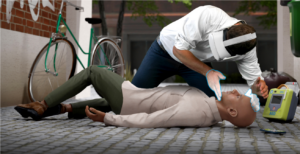
It allows learners to practice multiple scenarios, from a quiet living room to a busy supermarket, building both muscle memory and confidence.
“You almost always hear people coming out of our simulation saying, ‘Now I’m ready. I wouldn’t hesitate a moment to give CPR,’” Leon shares.
Instructors cannot fully track every guideline during practice.
“This type of learning provides the full picture, we can objectively measure many things that are not measured in traditional ways of training. If you train CPR, you follow a couple of guidelines that are established. There are a couple of steps in these guidelines that are more difficult to emulate in a classroom and are not measured objectively in a classroom.
As a very simple example, one of the starting points of the guidelines is check for your own safety. What you need to do when you find someone with a cardiac arrest is that you have to look around. Is it safe? Because your own safety comes first. Because if you can’t make sure you yourself are safe, you shouldn’t start helping somebody else because you may not be able to finish the help you’re giving.”
With Immersive Learning you can objectively measure every single step along the way, and we measure how long it takes, how long people take, and you can obviously practice as often as you want to optimize your performance in providing CPR.”
Unexpected Insight: Aftercare and Emotional Support
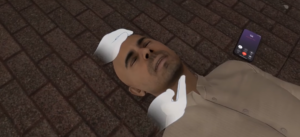
One of the most unexpected discoveries for Leon and his team has been the use of VR for aftercare.
“Recently, an instructor used VR with someone who had performed CPR in real life and was struggling with the emotional aftermath. He put the person in a VR simulation to relive what happened, and it helped them process the experience. That was never something we designed for, but it turned out to be incredibly powerful,” Leon recounts.
This demonstrates that immersive learning can go beyond what is expected. It can potentially help first responders and healthcare professionals cope with the stress and trauma of real-life emergencies.
“It took us by surprise, but it really shows the broader impact Immersive Learning can have. It’s not just about preparation. It’s about supporting people afterward, helping them deal with the aftermath of the event and potential PTSD,” he adds.
Misconceptions About VR Training
Leon identifies several common misconceptions about Immersive Learning.
“It makes you nauseous.”
- With well-designed software, that’s not a problem. We’ve never had anyone complain of nausea using our training modules.
“Complicated to use.”
- Our software is intuitive. We use hand tracking, so you don’t need controllers. Anyone can start practicing immediately.
“It isn’t real, so it won’t prepare me.”
- Of course it’s not real. But neither is a classroom. VR is high-fidelity enough to simulate real-life scenarios, and that’s what builds confidence and skill.
Motivating Learners Through Gamification
Immersive learning can turn a mandatory task into an engaging experience, especially for younger learners.
“We hear this a lot from instructors. Must becomes ”want” for students. So instead of they must learn CPR, they want to learn CPR. Gamification makes training so much more attractive. Young people are motivated to practice, try for a better score, and internalize the skills,” Leon explains.
Advice for Organizations
For organizations considering Immersive Learning, Leon has practical guidance:
“Start now. The experience you build using immersive learning today will be valuable for the future. Use the tools that exist and integrate them into your training.”
To Conclude
“With Immersive Learning, you can practice, learn, retain knowledge, and even manage the emotional impact of real emergencies. It’s a tool that can save lives,” Leon concludes.
Immersive learning is no longer a concept for the future. It is a practical, powerful tool that enhances skill, confidence, and emotional readiness for real-world challenges.
Check out more about Flashgroup Academy & Elementary here.
Schedule a demo here!